




Finmile is an AI-powered logistics execution platform that serves as an operating system for last-mile delivery, dispatch, and field operations. It provides end-to-end management, including AI-driven route optimization, proof of delivery (ePOD), returns management, and real-time fleet tracking.
Finmile has a strong footprint in London, Europe, and the US, helping logistics companies, e-commerce retailers, and delivery service providers (DSPs) cut costs by up to 42%.
Connect with Rich Pleeth here on LinkedIn.
00:00 – Why last-mile logistics is one of climate’s biggest hidden challenges
01:03 – The Problem: Why Logistics Still Runs on Spreadsheets
06:02 – Building Finmile
07:01 – Why Even Amazon Struggles with Last-Mile Logistics
09:18 – Inside Finmile’s AI Operating System
11:27 – What Agentic AI Actually Means for delivery workers
13:30 – Selling Cost Savings, Delivering Climate Impact
17:52 – Scaling Finmile
21:22 – Customer Success Stories
24:00 – Partnerships as a Growth Strategy
25:33 – What’s Next for Finmile
26:26 – The Future of Logistics
28:06 – What Finmile is Looking For
Efficient Logistics Routing - it’s also an environmental solution
When we think of logistics, we usually picture a fleet of delivery vans dropping off packages on our doorsteps. But logistics involves much more than parcel deliveries. One often overlooked aspect of urban mobility is service logistics. Take your local plumber or electrician as an example. We have all experienced the typical 9 am to 1 pm arrival window, leaving us waiting at home for hours. Efficient service routing helps address this issue by providing more accurate estimated times of arrival. Essentially, this is achieved by combining route optimization with parts management. Even before the journey begins, the software ensures that the right parts are loaded onto the right van, preventing double-trips and therefore avoiding unnecessary CO2 emissions.
While service logistics create opportunities for improving efficiency, delivery logistics show room for improvement as well. Consumers have become increasingly accustomed to same-day delivery, driven by what is often called the Amazon Effect. This shift is forcing more half-empty vans onto the road, which makes efficient routing even more important.
From Static to Dynamic Routing
According to Locus, routing inefficiency increases costs, causes longer delivery times, as well as low route adherence and increases fuel consumption. The European Commission also highlights that optimizing urban freight transport and last-mile delivery is instrumental in reducing congestion and emissions. By adjusting to real-time disruptions like traffic congestion and weather delays, as well as last-minute order changes, efficiency can be improved. Achieving this requires a shift from the current static system, where routes are planned the night before, to a more dynamic system which updates routes mid-journey with the help of AI.
Route Optimization
As explained by AREALCONTROL, route optimization relies on algorithms to improve delivery routes. These algorithms are designed to solve complex routing problems involving multiple vehicles.
There are different kinds of algorithms:
Shortest path algorithms solve the problem of finding the best route between two locations.
Vehicle Routing Problem (VRP) solvers address a more complex optimization problem by determining optimal routes for multiple vehicles, while satisfying constraints such as vehicle capacity, driver working hours, and customer delivery time windows.
AI based methods - for situations where demand patterns change quickly, for example, same-day deliveries.
The foundation of all optimization methods is high-quality data, including digital maps, GPS tracking, real-time traffic information, operational constraints, and other factors such as weather conditions.
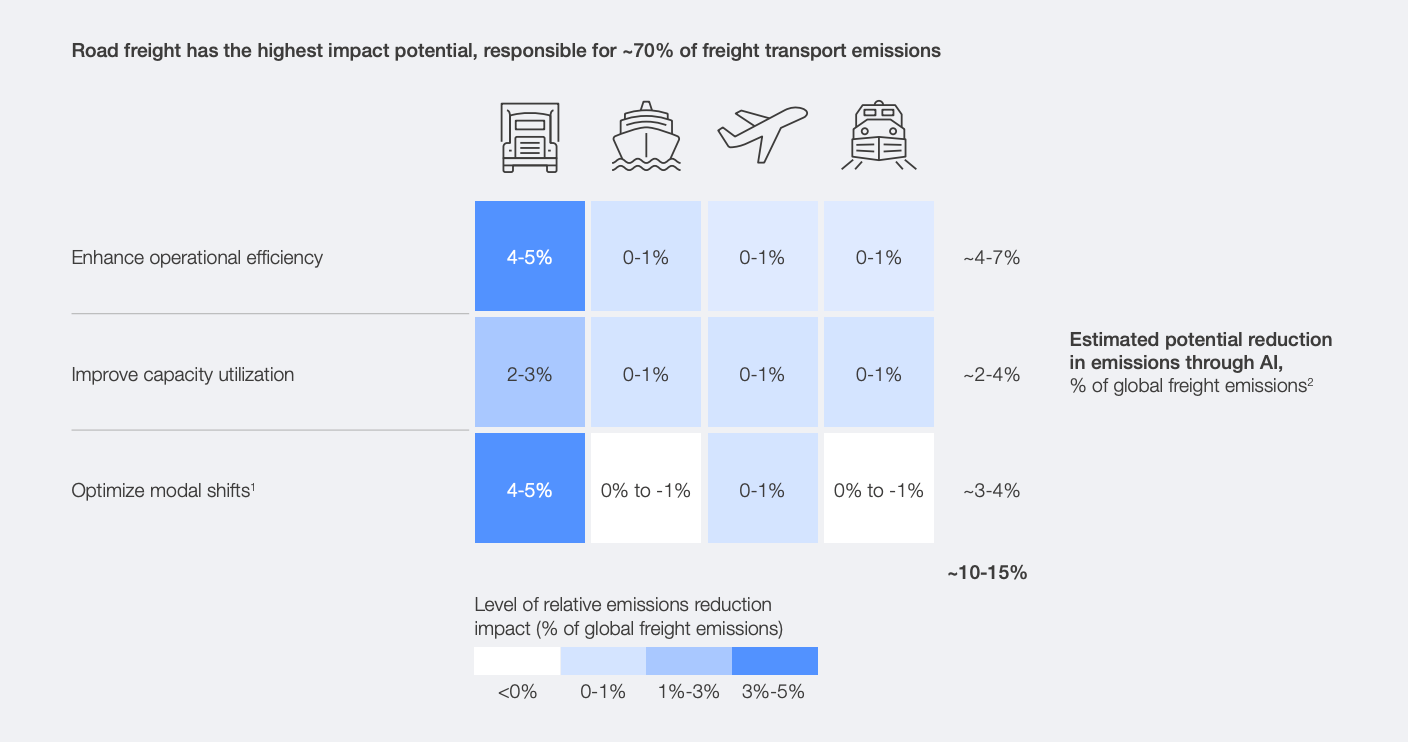
Source: World Economic Forum, Intelligent Transport, Greener Future: AI as a Catalyst to Decarbonize Global Logistics (January 2025).
Potential Reduction in Emissions through AI
According to the World Economic Forum, “the global transportation industry is responsible for up to 25% of all greenhouse gas emissions, with freight logistics accounting for 7-8% of global emissions.” AI offers a significant opportunity to reduce greenhouse gas emissions in the freight logistic sector. Enhancing the operational efficiency across road transport, maritime services, the aviation and rail transport, could reduce emissions by 4-7%. Further, improving capacity utilization could reduce global freight emissions by 2-4%. In total, the freight logistics industry could potentially reduce its emissions by 10-15%.
The climate impact is clear: efficient logistics reduces greenhouse gas emissions, air pollution, and improves local air quality, especially in traffic-congested areas.


