



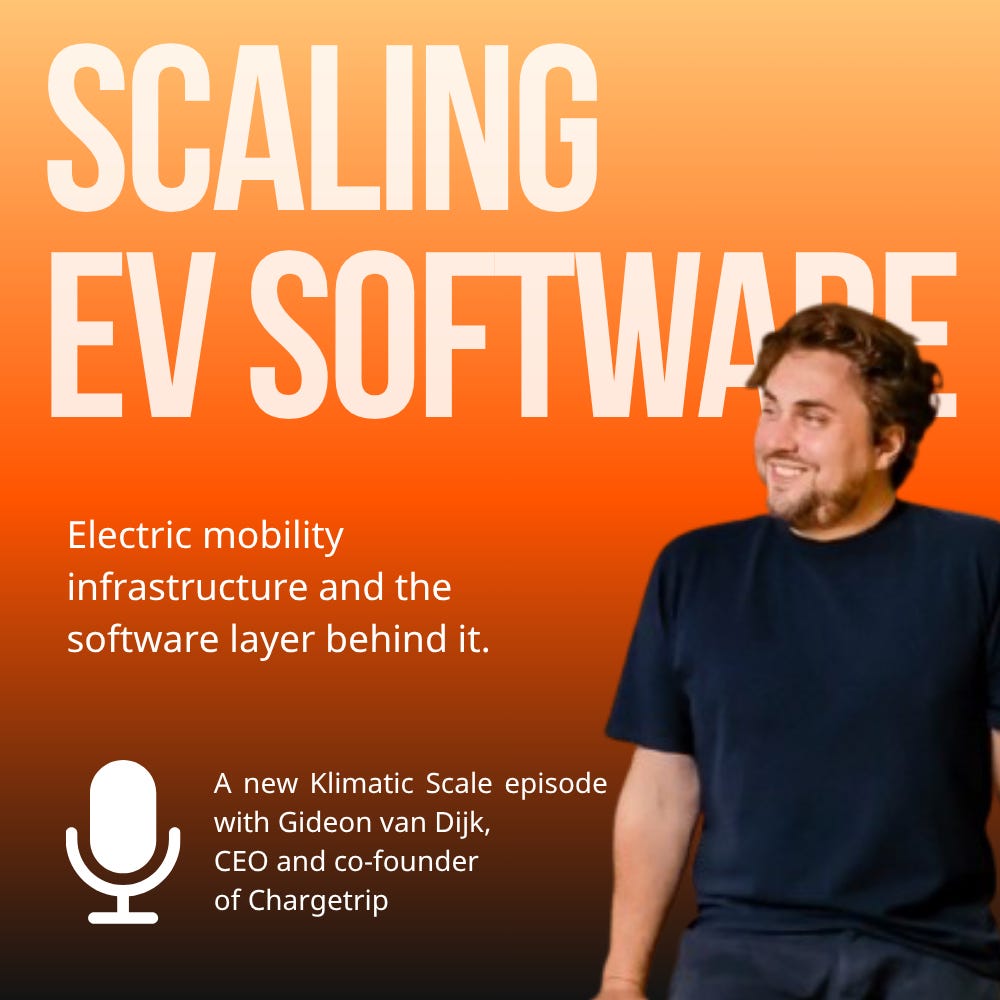
Chargetrip is an Amsterdam-based software company that provides a smart EV (Electric Vehicle) routing engine and e-mobility intelligence platform. Through its APIs and no-code tools, it helps automakers, fleet operators, and charging networks build custom route planners, simulate energy consumption, and predict accurate real-time driving ranges for over 1,500 EV models.
Headquartered in the Netherlands, their technology is widely integrated into brand-owned apps, web-based route planners, and in-car navigation systems for companies like Porsche, Siemens, and Plugsurfing.
Connect with Gideon van Dijk on LinkedIn.
00:00 – The Problem Chargetrip Solves
03:45 – 10 Years Building in E-Mobility
06:30 – What They Got Right (and Wrong) About EV Adoption
08:00 – The First Customer: Norway’s EV Association
11:00 – How Chargetrip’s Routing Engine Works
14:00 – Different Customers, Different KPIs
17:00 – The Hardest Part of Scaling
19:30 – Selling into Automotive and Energy Giants
24:00 – Commercial EV Fleets: The Next Growth Frontier
27:00 – Advice for Mobility Founders
29:00 – Closing Thoughts & What’s Next
The State of European EV Charging Infrastructure
The electric vehicle (EV) market is transitioning from an early phase focused on mass deployment of charging points to a phase focused on expanding overall charging capacity, mainly through high-power charging. Consequently, local grid constraints are emerging as one of the main bottlenecks.
State of the Market
According to the International Energy Agency (IEA), global private charging points for light-duty vehicles (LDVs) reached over 43 million in 2025, supporting a global electric LDV fleet of roughly 76 million. Meanwhile, the public charging infrastructure expanded by more than 33% in 2025, surpassing 7 million public charging points worldwide.
With the diversification and maturation of the EV market toward an economic mass market, the average price of a vehicle decreased while battery capacity and driving range remained broadly stable.
At the same time, higher oil prices increased the financial attractiveness of EVs. The IEA notes that financial savings associated with driving an EV rather than a gasoline car have risen between 20% and 45% in most countries.
Home vs. Public Charging
Home charging remains the preferred and cheapest method. In Norway, 90% of EV owners can charge at home. Many European countries offer direct subsidies for charging at home.
To prevent residential charging from overloading local grids, regulatory frameworks have been increasingly introduced in Europe:
Germany: Key regulations such as §14a of the Energy Industry Act (EnWG) incentivise grid-friendly charging and smart load management by allowing distribution system operators to temporarily control flexible loads during periods of grid congestion, in return for reduced grid charges.
The Netherlands: According to the Charging Report 2026 by gridX, the majority of home charging EV drivers already have solar (PV) systems, making smart home charging the standard baseline in the Netherlands.
In contrast, public fast charging is associated with a considerable price premium. In some markets, public fast-charging tariffs can be up to 240% higher than residential electricity rates.
The High-Power Transition
Worldwide deployment is increasingly prioritizing high-power, ultra-fast charging. The IEA shows that the average speed of charging points worldwide increased by 15% in one year, rising from approximately 40kW in 2024 to nearly 50kW in 2025.
Germany: In Europe, Germany leads in the deployment of ultra-fast chargers, with its share of ultra-fast chargers increasing from 4% in 2020 to 19% in 2025.
The Netherlands: Following its leading position in Europe in terms of density, the share of high-speed chargers in the Netherlands doubled, while slow chargers experienced a relative decline.
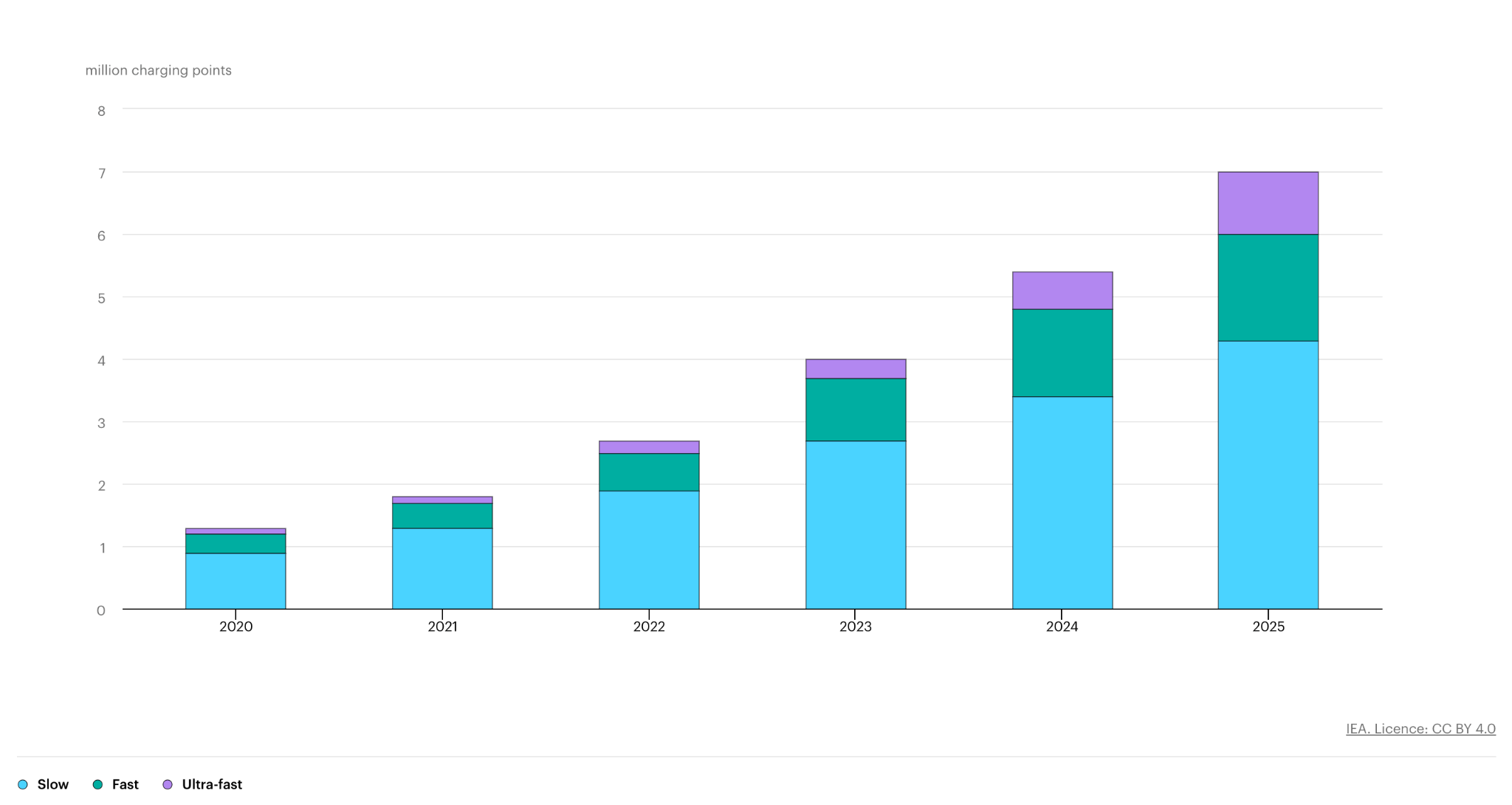
International Energy Agency (IEA) (2026). Licence: CC BY 4.0.
Commercial Fleet Electrification
While dedicated charging infrastructure for electric trucks and heavy commercial fleets grows steadily, overnight depot charging will remain the backbone of such fleets for many years. However, there is growing momentum behind heavy-duty vehicles (HDVs) charging corridors on the highways.
China: Leads global development with 5,000 to 9,000 public HDV charging stations – representing an estimated 70,000 individual charging points – supported by integrated grid planning.
Europe: Follows with over 4,000 public HDV charging points, supported by major EU funding commitments such as the Alternative Fuel Infrastructure Facility (AFIF).
Smart Grids & Virtual Extension
The most pressing constraint on the development of high-power fast charging remains the grid, as high-power fast charging also creates energy demand peaks. To bypass grid upgrade delays, digital and hardware solutions are increasingly gaining relevance:
Virtual Grid Extensions: Using battery energy storage systems (BESS) at charging stations to moderate power on-site.
Software Optimization: Implementing dynamic tariff management, peak shaving, and dynamic load balancing.
Finally, fast-charging corridors are expanding providing more flexibility for EV users. Nevertheless, home charging remains the backbone of e-mobility, and private charging capacity is expected to increase almost ninefold by 2035.


